

We don’t just write about famous superbikes from the late 80s and 90s. A motorbike doesn’t have to be big or powerful to be in the spotlight of our Classic Crush series. Hence the Honda Monkey.
Is there a motorcyclist who doesn’t know the Monkey? It’s a name that rings a bell for many. This popular mini bike is one of the best-selling motorcycles in the world. The Honda Monkey may be small, but it has a big personality. Over time, the Monkey has grown in size. Officially, it is still a mini bike. But for those who only know the Monkey of today, it used to be a lot smaller, with an engine of only 50cc. We’ll tell you more about this little firecracker.
Let’s go back to 1961. It was the year a new attraction opened in Tokyo’s Tama Tech Park. This park included a section dedicated to Honda Motor. In addition to offering motorbike-related attractions, it also served as a testing ground for new models. The stars of the new attraction were 50cc mini motorbikes. The first mini bikes.
The attraction was actually designed for children, but as soon as it opened, adults were queuing up to squeeze themselves onto the mini bikes. It was a huge hit right from the start. Adults folding themselves onto mini motorbikes, then racing around a small circuit.
The star attraction was the Honda Z100. One of the media guests said that the adults looked like monkeys as they rode around on the small motorbikes with their arms and legs spread wide. The iconic mini bikes have never lost that name.
In 1963, the brand launched the street-legal Honda CZ100. Initially, Honda focused its sales practices primarily on the Asian and European markets, where the CZ100 was launched in 1964. But mini bikes were also already wildly popular in America. There, small motorcycles with engined from lawnmowers were already available. One can only imagine what it would have done to sales if Honda had also launched the CZ100 directly in the US. However, at that time, the brand focused on the CB450 in the US, which also proved to be a very smart move.
It took seven years before the first real Honda Monkey rolled off the assembly lines. This was the Honda Z50 Monkey. Honda was not the first company to offer minibikes. As mentioned earlier, small motorcycles with lawnmower engines were already being manufactured and sold. But when Honda entered the market with the Monkey, they became the market leader almost immediately.
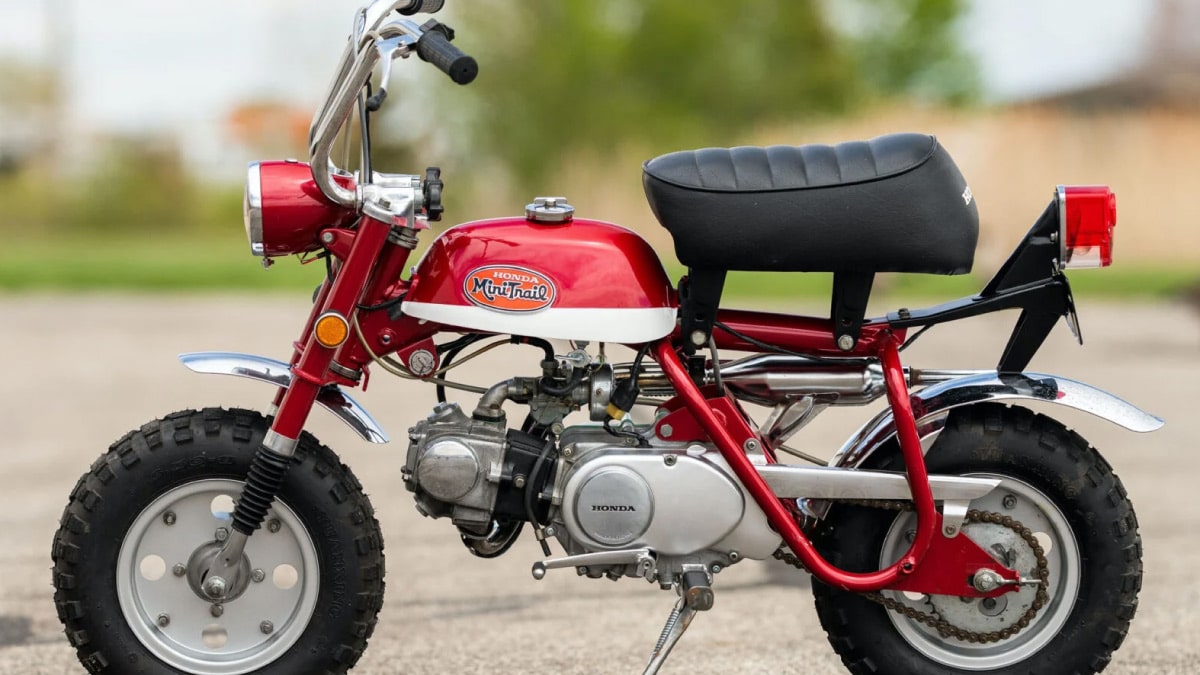
Engine: 49 cc four-stroke
Power: 2.4 hp / 1.8 kW
Seat height: 574 mm / 22.6 inches
Tank capacity: 4.9 litres / 1.3 gallons
Dry weight: 49.5 kg / 109.1 pounds
Top speed: 40 km/h / 25 mph
The second generation of Honda Z minibikes – which laid the foundation for the Monkey’s stardom – were also known as the “Hard Tail” Monkeys. These are iconic little bikes. The thick saddle – which was larger than the fuel tank – immediately catches the eye. But don’t be fooled. They weren’t nicknamed “Hard Tail” for nothing. Due to the lack of rear suspension, riding the Honda Monkey Z50A was not particularly comfortable. In 1972, the Honda Z50A was finally blessed with rear suspension. This was reason enough for a new nickname, the “Soft Tail” Monkeys.
The iconic Honda Monkey Z50Z was introduced in 1970. This mini bike had front suspension with the option of quickly removing the front forks and front wheel. This made it even easier to transport the small motorbike in the boot of your car, for example. The Z50Z had a centre stand, which made removing the front forks quick and easy. Over the years, the Honda Monkey has undergone quite a few changes.
The 1974 Honda Monkey Z50J had solid rear suspension and an independent rear swing arm. Four years later, in 1978, the first Monkey was launched with the well-known teardrop-shaped fuel tank. This was first seen on the Honda Monkey Z50J-I. The tank also reached a capacity of 5 litres at that time. Then, in 1985, the first Honda Monkey with a manual clutch was introduced.
Over the years, countless variations on the Honda Monkey have been created. Think of off-road versions such as the 1979 Honda Z50R. This minibike was Honda’s answer to the growing demand for mini motocross bikes. The Z50R had slightly more power than the previous Monkeys and proved to be a huge hit. Mini motocross competitions sprang up everywhere. Today, the Honda Monkey Z50R is one of the most sought-after minibikes among collectors around the world.
But there is also the Monkey Baja Africa. This is one of the rarest Monkeys. It is the ultimate dream for every minibike collector. Technically speaking, the Baja Africa was not built by the Honda factory. The Baja with the double headlight was, but the Africa kit was not fitted at the factory. Honda made a kit that you could purchase and then fit yourself to the Baja Monkey. This kit included a tank, side panels, rear fairing, front mudguard, engine guard, wind deflector and everything you needed to fit it all to your Baja.
It was fairly easy to do. It transformed your Monkey Baja into a miniature version of the hugely popular Honda Africa Twin. Because the Africa kit was produced in limited numbers, it is one of the rarest and most sought-after versions.
Several limited editions were also produced over the years. Think of a chrome version of the Honda Monkey. But also a completely gold version.

Production of the Honda Monkey Z50 series was discontinued in August 2017. Before production ended, a final limited edition was produced. This 50th anniversary special was only available to Japanese consumers. Fifty years of production is a very long time. Not many motorcycle models manage to stay in production for that long. It shows how popular the Monkey was. And still is, to be honest.
In 2018, Honda announced the revival of the Honda Monkey. In 2019, the first “next generation” Monkey was launched. The 2019 model is not really a true Monkey anymore. The iconic 50cc engine has disappeared. So has the charm of its small size, which made it so popular all over the world.
The 2019 Honda Monkey is based on the Honda Grom and therefore has the same 125cc engine. This is combined with the styling and colour scheme of the old, familiar minibikes. Then the name “Monkey” was put on the side and voilà. Is it really a Monkey? Our opinions are divided. But one thing is certain: it’s still a very nice mini motorbike to look at.
The Honda Monkey has probably stolen more hearts in the motorcycling world than any other motorbike. Ever. With its small, chunky tyres. The small “ape style” handlebars. The small fuel tank that has just enough capacity to guarantee lots of fun. And the large cushion as a seat. It wasn’t just a timeless motorbike when it was introduced. It was fantastic, right from day one. And it has never lost that charm.
Not everyone will have the money to buy one. But I can’t think of a motorcyclist who would say “No, thank you” if given the chance to get one at a bargain price. Because these endearing mini bikes are not exactly cheap. You’ll easily pay €4,000 to €6,000 for an older Z50 model in good condition. The new Monkeys go for €5,000.

The Honda Monkey is one of the most enjoyable motorcycles ever made, in our opinion. And a production period of 50 years shows that demand remained high throughout all those years. It was a hit from day one. And actually, the Monkey required very few modifications.
Nowadays, the first generation Z series is highly sought after by collectors. People want those less comfortable, old Monkeys. Because they look so good and are so much fun to ride.
The Monkey has been updated and slightly revised over the years. But it has always retained its unique charm. Even the new 125cc Monkey has that look and feel.


We use cookies to improve your experience on our site. By using our site, you consent to cookies.
Websites store cookies to enhance functionality and personalise your experience. You can manage your preferences, but blocking some cookies may impact site performance and services.
Unfortunately, we cannot find what you are searching for!

