

A true vintage superbike. That’s how the Ducati 916 SPS can be described with respect. It’s not just huge Ducati fans who will have heard of this motorbike. The name often rings a bell with superbike fans too. We’ll tell you more about this Italian Classic Crush.
Italy and racing. A combination made in heaven. We previously wrote about the successful Bimota YB4 from this beautiful country. Yet it has a Japanese heart. A classic Italian superbike through and through? Then you end up with the Ducati 916.
The Ducati 916 SPS is not “just one of the superbikes” from the Bologna-based brand. It is one of the most iconic motorcycles of all time. Why? To start with, thanks to its revolutionary design. May we point out that the styling of the 916 laid the foundation for today’s Panigale?
The famous Ducati 916 was introduced in 1994. The Classic Crushes from our previous articles are all a bit older. And until the introduction of the 916, all famous superbikes had iconic round or square headlights. Think of the Honda RC30 or the Suzuki Slabby. Ducati took a different approach with the 916, giving it almost “sultry-looking” headlights with new technology.
The creative mind behind the Ducati 916 was Massimo Tamburini, one of the founders of Bimota. Tamburini was not only responsible for the design, but also had a say in quite a few technical choices. And by making those choices, he created a motorcycle that stood out from the rest. Incidentally, he not only designed motorcycles for Ducati and Bimota, but also for Cagiva and MV Agusta.
The original Ducati 916 was launched as a “monoposto”, which means it came with a single seat. In other words, it followed the classic racing standard. In 1995, the 916 Biposto was introduced. You may have guessed it already, but the Biposto came with a dual seat. This made it possible to ride this red devil with a passenger.
Engine: 90-degree L-twin cylinder four-stroke with desmodromic valves
Power: 123 hp (90.4 kW) @ 10,500 rpm
Seat height: 790 mm / 31.1 inches
Fuel tank capacity: 17 litres / 4.4 gal
Dry weight: 190 kg / 419 lbs
Top speed: 269.3 km/h / 167.3 mph
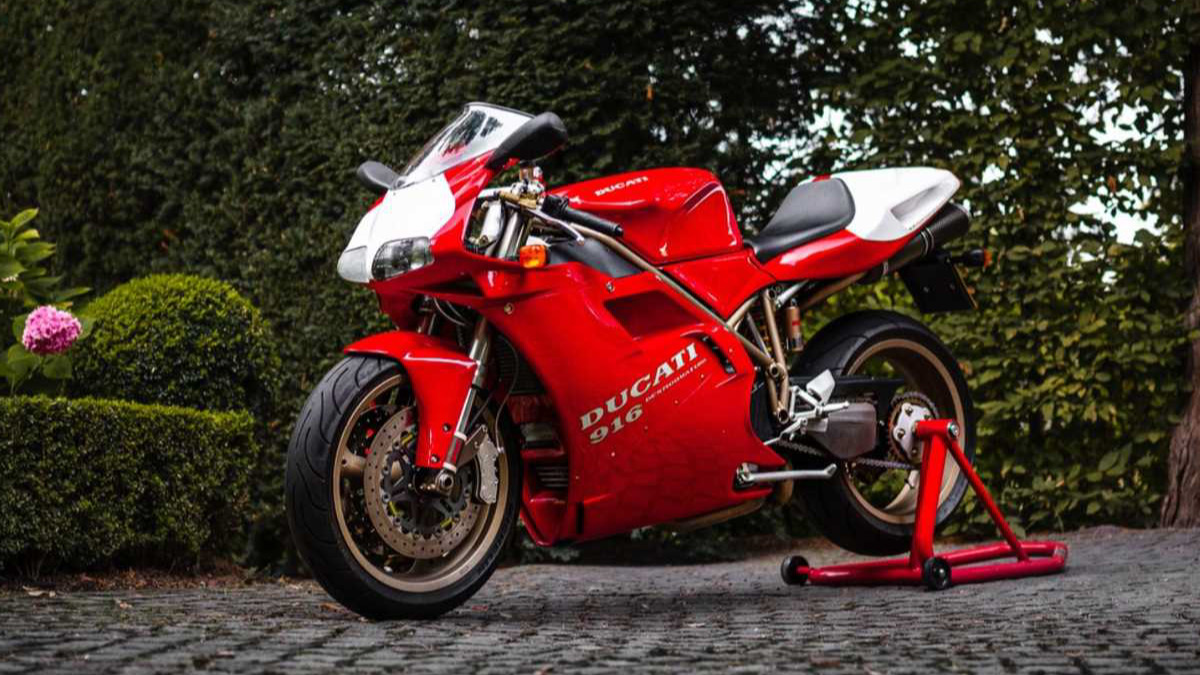
The Ducati 916 SPS version was launched to homologate the new 996 cc engine. Only then could the Ducati racing teams use the new engine in the Superbike World Championship. The previous engines used in Ducati’s racing bikes were known for developing stress fractures and breaking down under the high pressure of racing. This required the strengthening of the crankcases. There was also a desire for the engine to come closer to the 1000cc limit for two-cylinder bikes in the Superbike Championship. The homologated Ducati 916 SPS made that dream come true.
The Ducati 916 SPS had a lighter crankshaft and connecting rods. This made the engine rev quickly and build up speed faster than most racers were used to. However, due to the reduced flywheel effect, the 916 SPS was not actually much faster than its predecessor. But that did not detract from the almost manic feeling the engine gave you while riding. So it gained a reputation for being one big thundercloud that felt much faster than the dyno figures suggested.
When the SPS version of the Ducati 916 was launched in 1998 at a price of no less than 24,000 US dollars, fans seemed to have no problem with that at all. The limited production run of 404 units sold out almost immediately. Only a few were bought by collectors and safely stored away.
The Ducati 916 SPS did not get much more power than the original 916. For some, that was a disappointment. But the SPS version did have a considerable amount of extra torque. That made test riders very happy. The second gear power wheelies made more than a few testers sweat profusely. In general, the 916 was not really a motorcycle for riders with a heavy right wrist. At the time, it was almost a killing machine if you rode it without the necessary respect for the machine.
How much torque does the Ducati 916 SPS have exactly? 91 Nm @ 6,900 rpm. To put that into perspective, that’s more torque than a modern 2018 Yamaha MT-09 has. And you’re already confronted with it at lower revs.
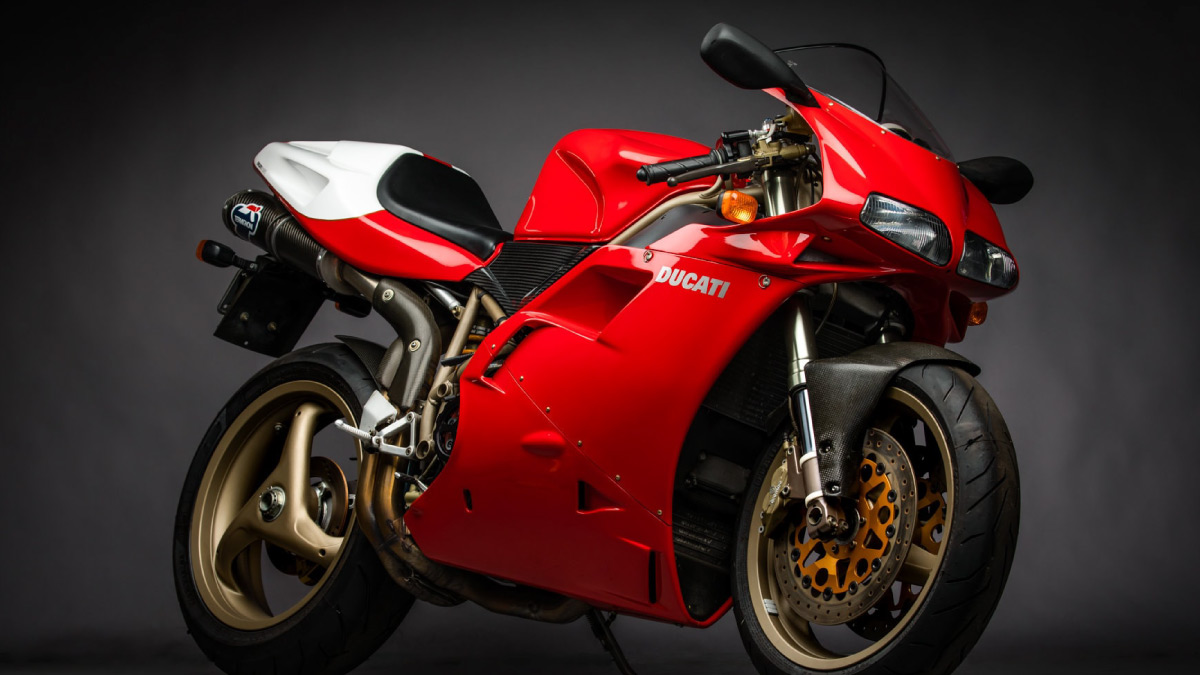
Did you notice? We mentioned something about the homologated engine in one of the previous paragraphs. The homologation model was the Ducati 916 SPS, which followed the original 916, the 916 Biposto and the 916 SP.
The SPS followed in order to homologate the new 996 cc engine. All previous Ducati 916s had a 916 cc engine. After modifying the engine to 996 cc, the 916 retained its original name. A bit misleading, isn’t it?
Later in 1999, Ducati changed the name of the model to “996”, so that the new model and name matched the actual engine capacity.
While many successful brands in racing are now often better known for their popular street bikes (especially naked and adventure bikes), the Ducati brand always seems to go hand in hand with racing. Nowadays, when you say “Ducati”, someone almost always responds with “Panigale!”. And personally, we think that’s fantastic.
We know that sports bikes are a dying breed on public roads. Modern motorcyclists simply seem to have a greater preference for naked bikes and adventure and/or all-road bikes. But we love how Ducati consistently makes the most extreme sports bikes in the motorcycle industry. Not just for the track, like Yamaha and KTM do.
Don’t get us wrong. We completely understand that brands are pretty much abandoning sports bikes for the road. And they are only developing them further purely for racing. But somehow we find it very admirable how Ducati sticks to its racing roots. And let’s be honest; they’re also very good at it.
With such deep-rooted racing heritage, it comes as no surprise that the Ducati 916 has built up a respectable track record. In its first year of production, the 916 was immediately entered into racing and won the 1994 Superbike title with Carl Fogarty. Remember that Dutch saying, “You can’t stand on one leg”? Carl probably thought so too, because he repeated the feat the following year.
In 1996, the Ducati 916 also won the world title, this time in the hands of the notorious Troy Corser. The Honda RC45 stole the world title in the Superbike championship from the Italians in 1997. But in ’98 and ’99, Ducati was back at number one, again with Fogarty. Only this time on the 996, the successor to the 916.
The ball bounced back to Honda in 2000, but Troy Bayliss brought the title back to idyllic Italy in 2001. This time on the 996R. Potential to win championships? Check, for the Ducati 916.
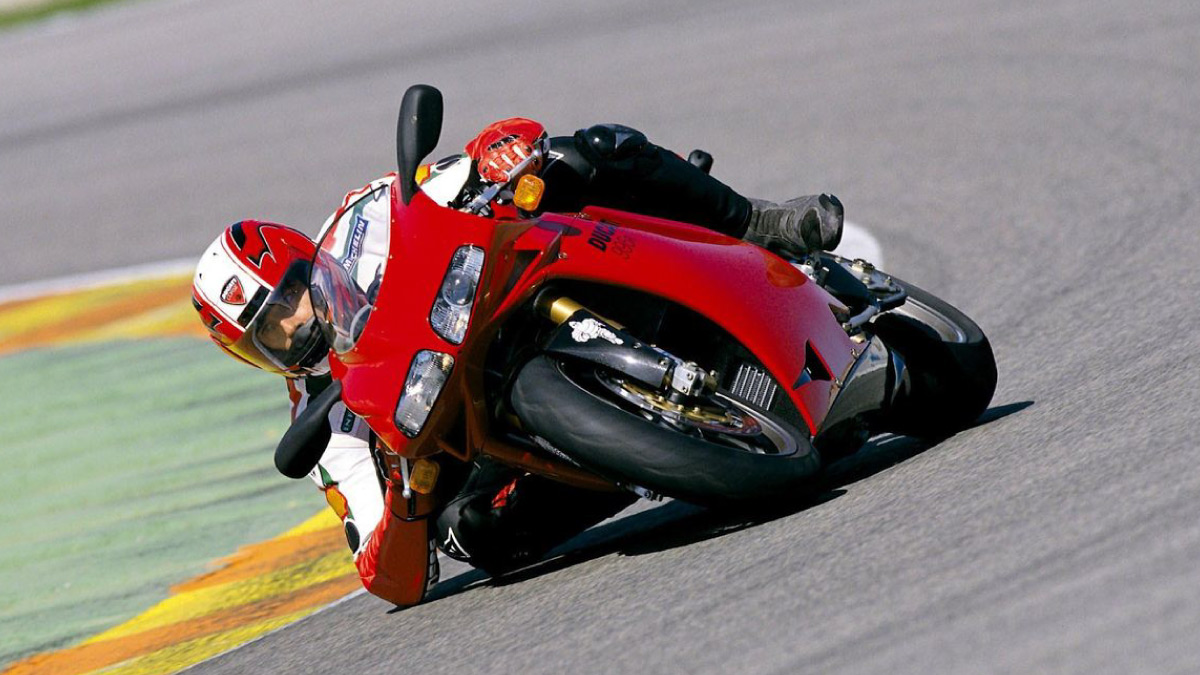
The Ducati 916 was revolutionary from the moment it was launched. The brand broke with tradition in terms of the use of round or square headlights. And the great Massimo Tamburini did a fantastic job designing this historic motorcycle. In doing so, he created one of the most successful race bikes in history.
The 916 feels like a maniac. It is quite a handful to ride and demands a certain amount of respect. But that manic feeling also made the bike hugely popular. It seemed as if it came from another world. And it proved to be very successful in the one thing it was designed for, with six world titles in the Superbike class to its name.


We use cookies to improve your experience on our site. By using our site, you consent to cookies.
Websites store cookies to enhance functionality and personalise your experience. You can manage your preferences, but blocking some cookies may impact site performance and services.
Unfortunately, we cannot find what you are searching for!

