

For our Classic Crush series, we look beyond Japan. Hello, Italy! And because we love surprises, we’re putting a brand and motorbike in the spotlight that you might not immediately think of. Meet the Bimota YB4. A true Italian superbike from 1987.
Fans of exotic superbikes have probably heard of the Bimota YB4. But if you’re not a fan, the brand is mainly an underdog. In 2020, the brand made global headlines with their brand new Bimota Tesi H2. This futuristic sports bike bears no resemblance to the YB4. Yet both are eye-catching.
The Bimota YB4 was first seen in the “R” form, the YB4R. Once again, the letter R stands for the superbike version. It was admitted to racing in the Superbike World Championship. The Bimota YB4R made its debut in the Bol d’Or endurance race in 1986. Big names rode this racing machine in the 1987 World Championship and did so very successfully. Think of Virginio Ferrari and Davide Tardozzi. The latter is the current team manager of the MotoGP factory team.
Bimota is a very Italian brand. The brand was started in 1973 in Rimini by three partners, namely Valerio Bianchi, Guiseppe Morri and Massio Tamburini. Tamburini is probably familiar to many. He is known for his design work for various motorcycle manufacturers, such as Cagiva, Ducati and MV Agusta. The brand name “Bimota” is formed from the first two letters of the partners’ surnames.
Initially, the brand focused primarily on building high-quality chassis around existing engines. The Bimota YB4 is no exception. The YB4 is powered by a Yamaha FZ750 engine. This proved to be a very successful choice. Virginio Ferrari won the Formula TT title with the Bimota YB4 in 1987. Tardozzi then won five races in the 1988 World Superbike Championship. This semi-Italian race bike proved to be a damn good machine.
Engine: 749 cc transverse four-cylinder four-stroke
Power: 121 hp @ 10,500 rpm
Seat height: … mm / .. inches
Fuel tank capacity: 20 litres / 5.3 gal
Dry weight: 180 kg / 396.9 lbs
Top speed: 248 km/h / 154 mph
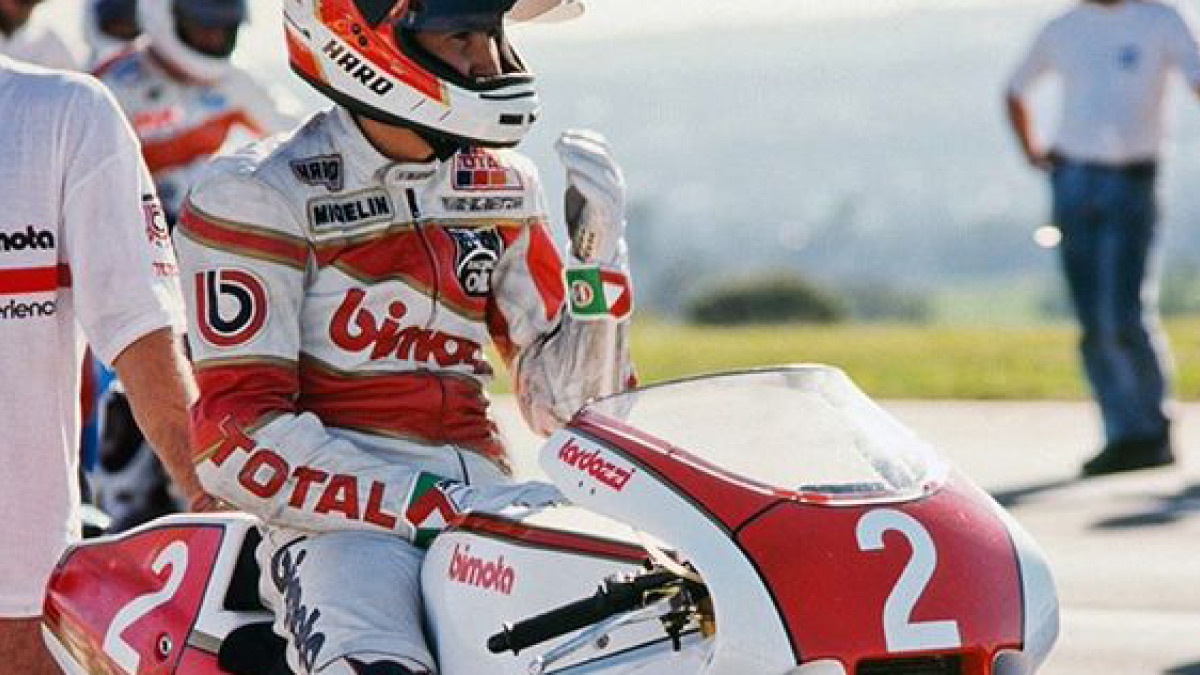
Like most of our Classic Crushes, the Bimota YB4 was produced in limited numbers. Only 303 units were manufactured, making it a valuable and sought-after motorcycle for collectors today. Initially, the YB4 was designed exclusively for the racetrack and was therefore not street legal. In 1988, the organisation behind the World Superbike Championship changed its rules. Homologation rules were added. This obliged Bimota to produce at least 200 road-legal YB4s before it could compete in the championship.
Thanks to homologation rules, it was finally possible to encounter a YB4 on the road, albeit very rarely. However, this YB4 was slightly different from the superbike used in Formula TT. The previous YB4 had carburettors, while the homologated YB4 had fuel injection. However, the new YB4 did have the same four-cylinder engine with five valves per cylinder as the FZ 750. Bimota wanted to give the new motorcycle a small performance boost. So the brand installed an electronic system from Weber Marelli.
But it wasn’t the power that made the Bimota YB4 so good. It was mainly the brilliant chassis. The quality of the design and production technology was so high that it stood head and shoulders above the rest. The power-to-weight ratio was ideal and the weight of the motorcycle in general was very low, especially for that time.
Interesting fact: the frame of the YB4 was not designed by Tamburini. He left Bimota in 1983. He was replaced by Federico Martini, a former Ducati engineer. Although he was quite young and relatively inexperienced when he joined Bimota, he designed the two best-selling motorcycles in the brand’s entire history. He was the creative mind behind both the Bimota DB1 and the YB4.
The YB4 was one of the first sports bikes to use an aluminium frame and swingarm. Bimota was a true pioneer at the time and took the first steps in the development of aluminium perimeter frames. Today, this is standard practice.
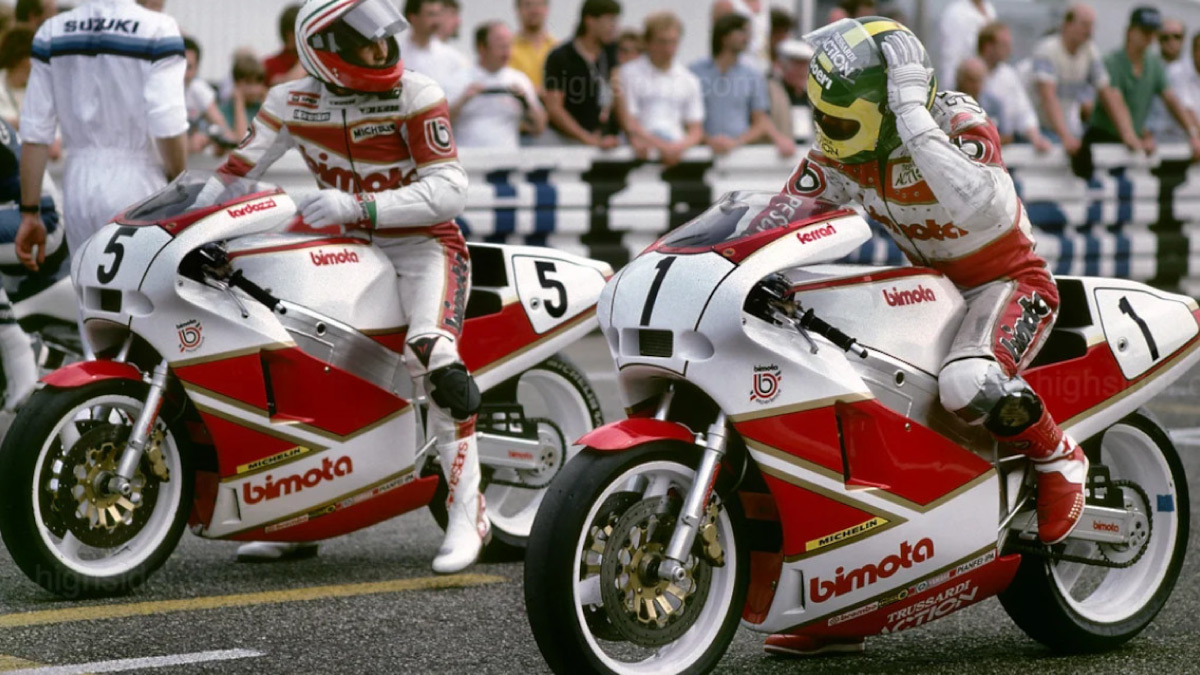
It was not such a surprise that the Bimota YB4 was so successful in racing, despite competing against big names in the world championship, such as Yamaha and Honda. The manufacturer Bimota was no match for these names in terms of size. But the YB4 handled so well. It was predictable, surprisingly forgiving and rode very smoothly.
The rider could trust the front wheel; it went exactly where the rider wanted it to go. The steering was sharp and responsive. Combine that with the stiff suspension and you have a very high-quality race bike. The brilliant chassis allowed for a short wheelbase, which meant you could turn the YB4 quickly without the bike becoming nervous.
The Bimota YB4 with the FZ750 engine was such a success that it practically forced Yamaha to take a step forward in the development of their racing bikes. Yamaha responded with the development of their FZR 750 R OW01 and their revamped FRZ 750 engine.
Whereas well-known motorcycle manufacturers produce homologation models in quantities that are well thought out from a marketing perspective, Bimota only produced the number of units necessary to comply with homologation rules. Very few were made. This was not an unusual choice in the 1980s. Yamaha and Honda employed a similar tactic with their OW01 and RC30.
But while most OW01 models ended up in living rooms or garages to be admired, the Bimota YB4 was mainly purchased by actual motorcyclists. Or rather, racers. The YB4 had by far the best frame of all the superbikes of the late 1980s. It also had a relatively advanced engine, especially with the addition of electronic fuel injection.
All in all, it is likely that 303 YB4s were produced between 1988 and 1989. In addition, 15 SP models were also made. No one knows exactly how many were made for consumers. Rumour has it that the number was slightly “inflated” to comply with the homologation rules for the Superbike championship. Bimota also claims that 200 units were destroyed during test rides of the motorcycle. So it remains a guess.
The whole mystery makes it not only a valuable motorbike, but also one that is difficult to find. Want to buy one? They go for prices of around €30,800 for a nice 1988 superbike model, or €12,000 for a well-used 1990 model. Which probably needs a lot of love and attention. Many collectors believe that prices will continue to rise, given that there are so few left.
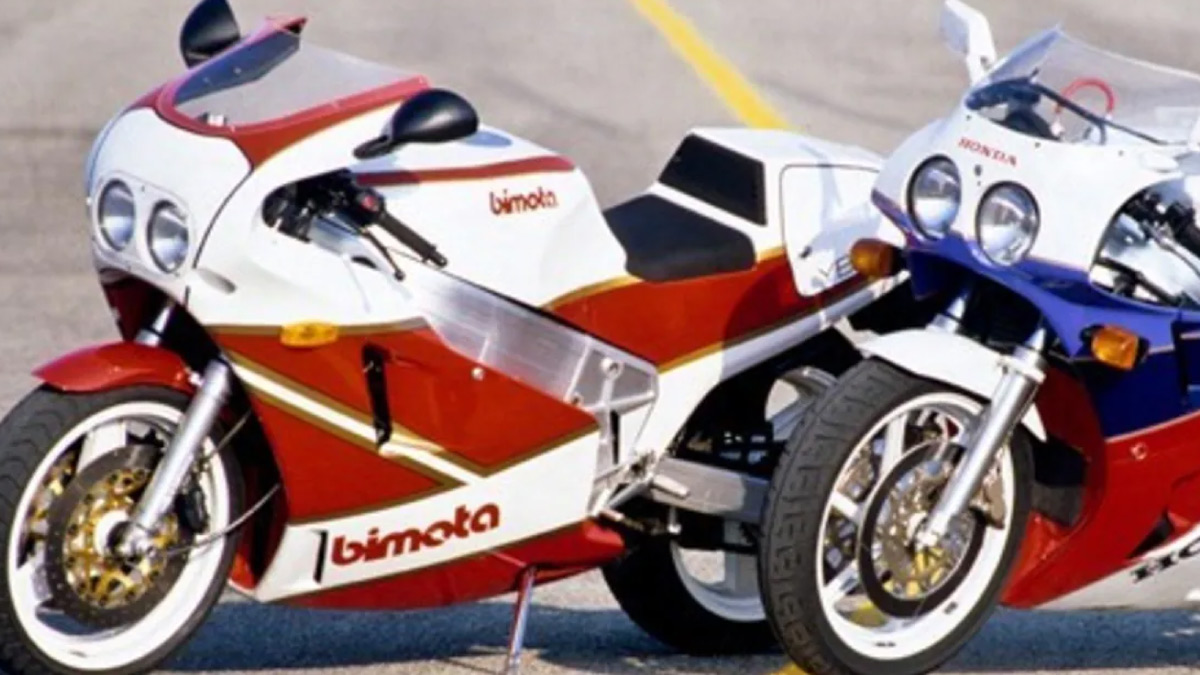
The Bimota YB4 is a genuine Italian race bike. At the heart of the motorbike lies a reliable Japanese engine, which has been improved by adding fuel injection. The YB4 stood out among the rest of the predominantly Japanese superbikes thanks to its brilliant frame, which was designed by Martini. It was the first superbike with an aluminium frame. This gave it a very favourable weight-to-power ratio.
As a racer, you could rely on the front end. It did exactly what you wanted it to do. This may sound like something every race bike should do. But it was far from common at the time. And if we’re honest, not even every modern day race bike does that straight from the factory. So the Bimota YB4 was actually ahead of its time. And that makes it more than worthy of a place in our Classic Crush series, if you ask us.


We use cookies to improve your experience on our site. By using our site, you consent to cookies.
Websites store cookies to enhance functionality and personalise your experience. You can manage your preferences, but blocking some cookies may impact site performance and services.
Unfortunately, we cannot find what you are searching for!

